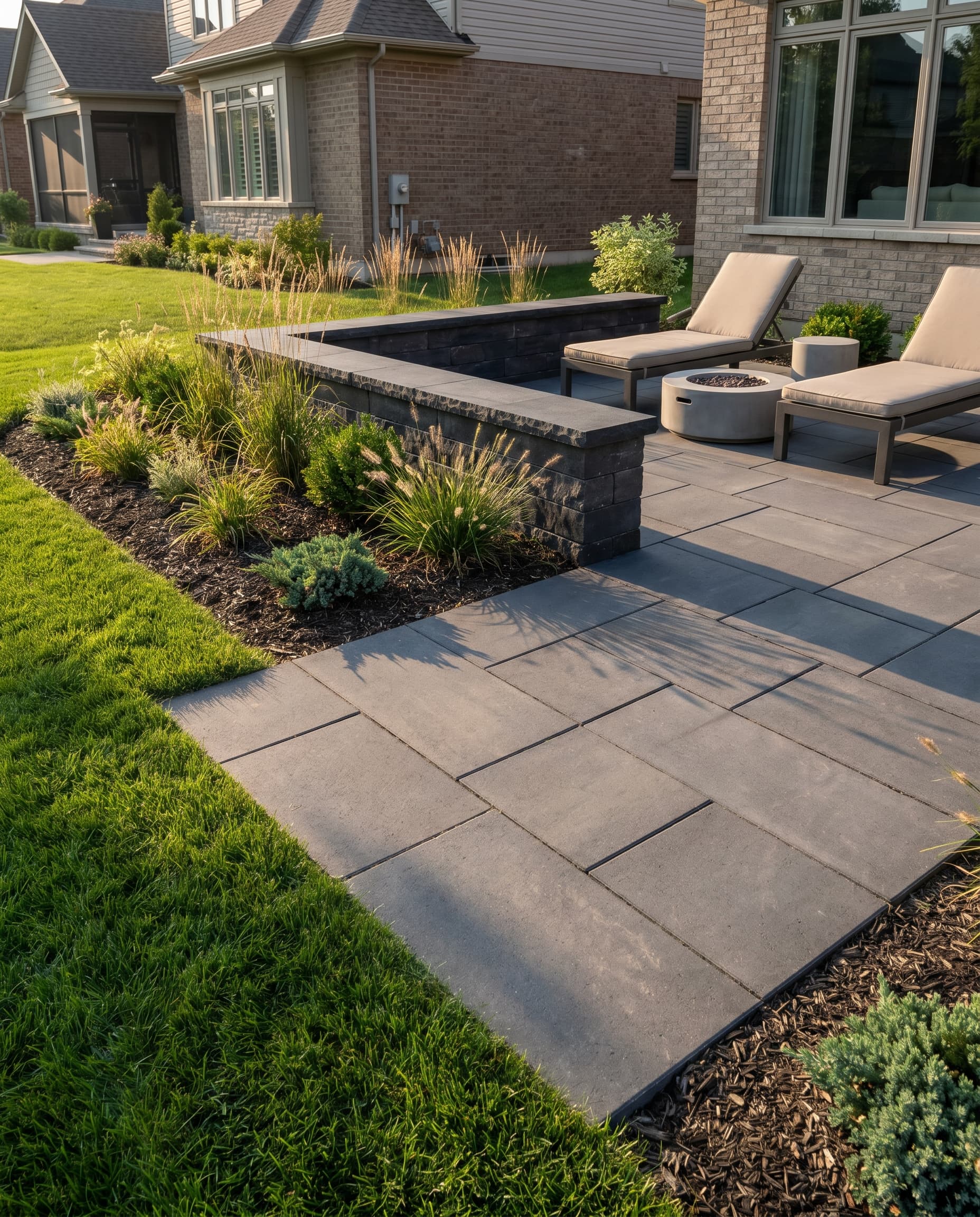
Built to last in Ontario winters. Proper base, proper drainage, done once — backed by our 3-year warranty.
Ontario's climate runs through 40 to 60 freeze-thaw cycles a winter. Water seeps into the base under your patio, freezes, expands about 9 percent, and shoves everything above it upward. Then it melts, the space collapses, and pavers drop back down uneven. Do that a hundred times and a shortcut patio starts to look like a skateboard ramp.
West GTA adds two more problems on top of that. Much of the region — especially lots in Oakville, Burlington, and south Mississauga — sits on heavy clay soil. Clay holds water instead of draining it, so the freeze-thaw punishment sits right under your pavers for months. The second problem is water migration: if your downspouts, grading, or drainage weren't scoped before the patio went in, water runs under the base and hollows it out from the edges. That's why so many “5-year patios” look 20 years old by year six.
The single biggest reason cheap patios fail is excavation depth. Big-box install guides sometimes say 4–6 inches of base is “fine.” It isn't — not for residential Ontario freeze-thaw.
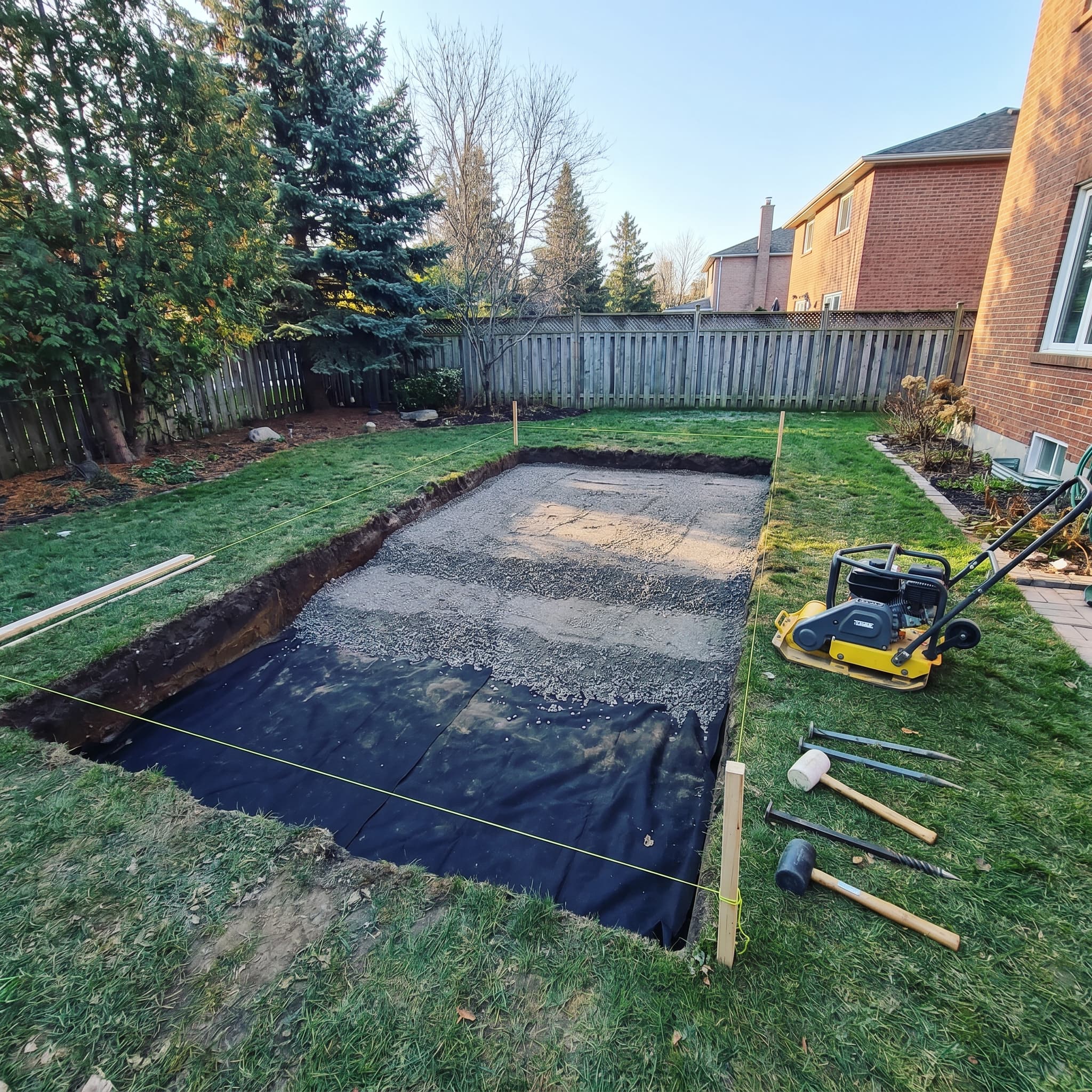
Our crews dig out 10 to 12 inches below the finished patio surface. That gives us room for a proper compacted aggregate base plus the paver and bedding layer on top. Cut corners here and the freeze-thaw line reaches the underside of your pavers — the exact layer you never want water freezing in.
Once the excavation is clean, we roll out woven geotextile separation fabric across the sub-grade before any aggregate goes down. Most contractors skip this step because it costs a few hundred dollars and adds half a day.
Here's what it does: it stops the native soil (especially West GTA clay) from pumping up into your aggregate base over time. Without it, freeze-thaw cycling mixes the two layers — soil migrates up, stones migrate down — and your clean base turns into a muddy mess. Fifteen years from now, a patio with geotextile still has a base. A patio without it doesn't.
This is where real paver patio base prep ontario either gets done right or gets faked. We build the base in 2-inch compacted lifts of 3/4-inch crushed aggregate (sometimes called Granular A or crusher run). Each lift gets:
Why not just dump 8 inches and hit it once? Because a plate compactor can only meaningfully compact about 2 inches of aggregate at a time. Dump more than that and the bottom half stays loose — and loose base is where pavers sink. A four-lift base takes a full day longer than a one-dump job. It's also the difference between a patio that still sits flat in 2041 and one that needs to be lifted in 2030.
Every patio we build pitches away from the house at a minimum of 1/8 inch per foot. That's the slope rule for West GTA residential — enough to move water, not enough to feel like you're eating dinner on a hill.
Slope gets set during base prep, not at the paver stage. We use string lines and laser levels across the compacted base so the finished paver surface lands at the right grade. Patios built flat or sloped toward a house are where water damage, ice sheeting, and foundation issues start.
Pavers want to migrate outward. Every time someone walks, every freeze-thaw cycle, every summer expansion — the field pushes against the perimeter. Without edge restraint, outer pavers drift, joints open, polymeric sand washes out, and the whole patio starts unraveling from the edges.
Our standard is heavy-duty PVC or aluminum edging, spiked into the compacted sub-base with 10-inch landscape spikes every 12 inches around the full perimeter. Not into the bedding sand — into the base. Edge restraint that's only staked into topsoil will heave out with the first frost.
We specify Techo-Bloc, Unilock, and Permacon — three Ontario manufacturers that publish freeze-thaw durability data and absorption ratings for every product line. Big-box concrete pavers don't. That's not branding; it's material engineering.
Premium pavers use denser concrete mixes, lower water absorption, and surface treatments that shed de-icing salts. They cost more per square foot. They also look the same in photos 15 years later — where a lower-grade paver spalls, fades, and flakes at the surface after three or four Ontario winters.
Polymeric sand goes between every paver joint. It's a mix of silica sand and polymer binders that hardens when activated with water. Done right, it locks the field together and blocks weed growth, ant intrusion, and water infiltration for 3–5 years before top-up.
The activation step is where cheap installs fail. We sweep the sand in dry, compact it once with a plate compactor and a rubber mat, sweep again, then mist — not spray — the entire surface in stages so the polymer wicks down through the joint without washing the sand out. Hit it with a pressure nozzle and you've got expensive mud.
After joints are filled and polymeric sand is activated, we run the plate compactor back over the entire patio surface with a rubber mat underneath to protect the paver faces. This final pass seats every paver into the bedding layer, locks the field, and squeezes any remaining voids out of the joints. Skipping this step is how a brand-new patio develops high and low spots in its first year.
A patio built for freeze thaw patio installation Oakville-area conditions looks the same in year 15 as it did in year 1. That outcome comes down to six things, none of which you can see once the pavers are down:
Miss one and the clock starts ticking. Hit all six and the patio outlives most of the other hardscape on the property.
Not usually. The ground needs to be workable — not frozen — to excavate, compact, and set base properly. Our build season in West GTA runs roughly late March through early December, weather-dependent. Winter is when we design, quote, and book slots. If you want work starting in April or May, the conversation happens in January and February. Frozen-ground installs end up with base problems by spring.
We build to 10–12 inches of excavated depth below your finished patio surface — enough for a full compacted aggregate base plus paver and bedding sand. Anything shallower sits inside the freeze-thaw zone. Some Canadian jurisdictions quote 6 inches as a minimum; in West GTA clay soil under residential freeze-thaw cycles, that's a recipe for a patio you replace in 7 years.
A few quick tests. Walk across it — any paver that rocks, tips, or sounds hollow signals a failed bedding or base layer. Look at the edges — open joints or drifted pavers mean edge restraint is gone. Check after a rain — water pooling on the surface means the slope was never set. If two or more of those are happening, you're looking at a demo-and-rebuild, not a surface repair.
Done right, polymeric sand joints stay locked for 3 to 5 years before they need a top-up, and a full re-joint every 7 to 10 years depending on traffic, sun exposure, and pressure washing habits. Done wrong — over-watered during activation, or swept in on dirty pavers — they fail in the first winter. We include a care guide at handoff so you don't accidentally ruin them with a pressure washer.
Water finds the path of least resistance. Under a patio with bad drainage, that path is usually your foundation, your neighbour's lot line, or a slow washout under the base. Six signs of drainage failure: efflorescence streaks, moss in joints, ice sheets in winter, pooling water after rain, heaving edges, and sinking corners. Drainage gets scoped before the patio quote — fixing it after is always more expensive.
Three reasons. First, published freeze-thaw and absorption ratings — you know what you're buying. Second, denser concrete and better surface treatments that shed Ontario road salt instead of spalling under it. Third, warranty and lot-matching — if a paver ever needs replacing years later, we can usually source a colour match. Generic big-box pavers rarely offer that, and it shows at year 5.
Most McCoy paver patio builds run 1–3 weeks on-site once excavation starts. Excavation and base prep alone usually take 2–4 days depending on size and access — and that's where we don't rush. Paver laying and jointing move faster once the base is right. Peak-season slots book 6–12 weeks ahead, so if you want a May or June install, reach out in the winter planning window.
The sequencing rule that decides whether pavers last or fail — drainage gets scoped before the patio quote.
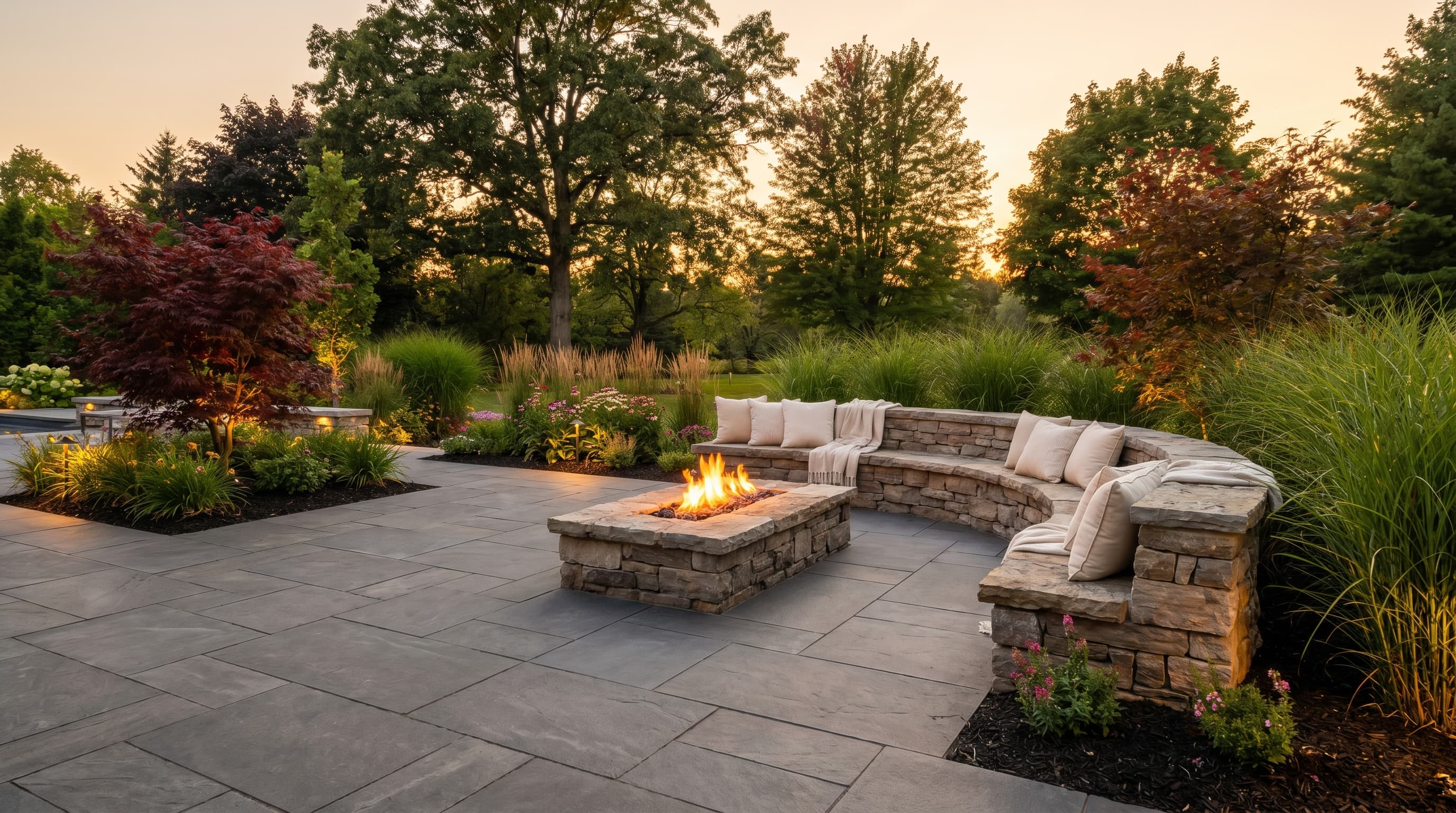
Scope, sequencing, timelines, and real costs for a full backyard build across Oakville, Burlington, Mississauga, and Milton.
Share a little about what you want built and we'll set up a no-pressure consultation. Every hardscape is backed by our 3-year warranty.